

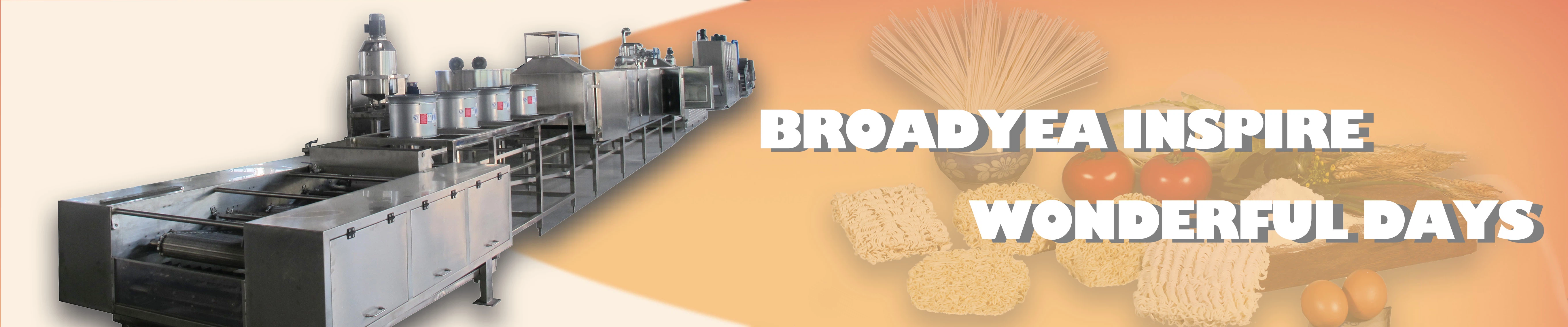
Stick Noodle Production Line
Before continuous rolling machine, the process equipment is the same as the frying noodle production line, also consist of folding machine and cutting machine. With the characteristics of special technology, novel structure, reasonable design, stable operation, safety, convenient maintenance and so on. Per shift is 4 to 12 tons. Roller width is 300 to 800 mm. The size can customized by customer.
Stick noodle production line refers to the industry segment dedicated to the manufacturing and assembly of machinery and equipment specifically designed for the efficient and large-scale production of Stick noodles.Stick noodle production lines are intricate systems comprising various components such as mixing and dough forming machines, steaming and frying equipment, and packaging machinery. These production lines are characterized by their ability to automate the noodle-making process, ensuring consistency in product quality and output.
Advantages of Stick Noodle Production Line
Efficiency in production
One of the primary advantages of a Stick Noodle Line is its ability to significantly enhance production efficiency. By automating various stages of noodle making, such as mixing, dough forming, rolling, cutting, and drying, the line streamlines the entire process. This automation not only accelerates production but also ensures consistent quality and reduces the need for manual labor, leading to higher output and cost-effectiveness.
Consistency and quality
Consistency is key in the food industry, and the Stick Noodle Line excels in delivering uniformity in noodle thickness, length, and texture. With precise control over the dough mixing and rolling processes, the line produces noodles of consistent quality batch after batch.
Customization and versatility
Noodle preferences vary widely, from thin and delicate strands to robust and hearty shapes. The Stick Noodle Line offers versatility through its customizable features. Operators can adjust parameters to create a diverse range of noodle varieties, satisfying the tastes of different markets and consumer segments.
Energy efficiency
Modern Stick Noodle Lines often incorporate energy-efficient components and systems. These machines are designed to optimize energy consumption without compromising on production capacity or quality. Energy-efficient operations contribute to cost savings and align with sustainability goals.
Scale and scalability
The Stick Noodle Line is available in various sizes to accommodate different production scales. Whether it's a small-scale artisanal noodle shop or a large commercial operation, the line can be tailored to meet specific needs.
Reduced wastage
Precise control over the production process minimizes wastage of ingredients, contributing to cost savings and environmental sustainability. The Stick Noodle Line ensures that raw materials are utilized optimally, resulting in higher yield and reduced resource waste.
-
![Hanging Noodle Machine Flour Conveying Equipment]() Hanging Noodle Machine Flour Conveying EquipmentFlour air transport equipment *By using the machine of Roots blower to form a difference pressure, which conveyor the flour into the temporary storage tank for backup. *Composed by Roots blower,...read more
Hanging Noodle Machine Flour Conveying EquipmentFlour air transport equipment *By using the machine of Roots blower to form a difference pressure, which conveyor the flour into the temporary storage tank for backup. *Composed by Roots blower,...read more -
![Straight Noodle Production Line Alkali Liquid System]() Straight Noodle Production Line Alkali Liquid SystemBroadyea straight noodle production line is a kind of advanced equipment, specially used for the production of high quality noodle product. The production line uses the lastest technology and...read more
Straight Noodle Production Line Alkali Liquid SystemBroadyea straight noodle production line is a kind of advanced equipment, specially used for the production of high quality noodle product. The production line uses the lastest technology and...read more -
![Waving Noodle Production Line Flour Mixer]() Waving Noodle Production Line Flour MixerFlour mixer *Flour machine is a horizontal with double shaft. The inner-tank are made of stainless steel304 material and the blended wing adopts integral precision casting and surface polishing....read more
Waving Noodle Production Line Flour MixerFlour mixer *Flour machine is a horizontal with double shaft. The inner-tank are made of stainless steel304 material and the blended wing adopts integral precision casting and surface polishing....read more -
![Straight Noodle Production Line Aging Machine]() Straight Noodle Production Line Aging MachineAging machine is commonly called waking the flour, which improves the processing properties of dough by means of time lapse. *To permeate water into the interior of protein colloid particles and...read more
Straight Noodle Production Line Aging MachineAging machine is commonly called waking the flour, which improves the processing properties of dough by means of time lapse. *To permeate water into the interior of protein colloid particles and...read more -
![Manual Noodle Equipment Compound Rolling Machine]() Manual Noodle Equipment Compound Rolling MachineCompound rolling machine *Adopt two group of feeder and one group of compound rolling. The group of feeder adopts the drawing roller, which can effectively reduce the damage of noodle belt and...read more
Manual Noodle Equipment Compound Rolling MachineCompound rolling machine *Adopt two group of feeder and one group of compound rolling. The group of feeder adopts the drawing roller, which can effectively reduce the damage of noodle belt and...read more -
![Straight Noodle Production Line Continuous Rolling Machine]() Straight Noodle Production Line Continuous Rolling MachineContinuous rolling machine *The placement of slitter in 10 degrees, can make the noodle of silk is even and tidy and reduce the weight difference in unit volume. *The material of roller and gear,...read more
Straight Noodle Production Line Continuous Rolling MachineContinuous rolling machine *The placement of slitter in 10 degrees, can make the noodle of silk is even and tidy and reduce the weight difference in unit volume. *The material of roller and gear,...read more


Why Choose Us
Professional team
Broadyea® who is specialized in Noodles Machinery Manufacture by R&D,production,sales,after-sales service,
Rich Experience
We have a great experienced design engineers and manufacture technicians with more than thirty years experience, which forms a rounded management system of rules and process.
Global Shipping
And our productions are exported to USA, Brazil, Roumania, Southeast of Asia and many other countries.
Custom Service
Our company are not only to provide the equipment to our customers, but also furnish customers with relevant the process of production and technical assistance, as well as the equipment of installation, setting-up, personnel training, after-sales service etc.
Things To Consider Before Choosing Noodle Production Line
Safe Material
As food production machines, all the materials used should be food grade. If unqualified materials are selected, harmful substances may be produced during the production process. The most suitable material is stainless steel, which is a food-grade material and has no adverse effects on health.
Durability of the Machine
Before you select the machine, not only the quality of material but also the manufacturing technique should be taken into consideration. That’s because investing in an inferior machine may bring you a lot of follow-up trouble. For example, the noodles produced are not qualified, the machines need frequent maintenance and so on. Therefore, ensure that the machine you purchase has better durability and a warranty.
Easy Operation
These machines should be easy to operate because simple operation can make production more efficient.
Process Flow of Stick Noodle Production Line
Dough mixing
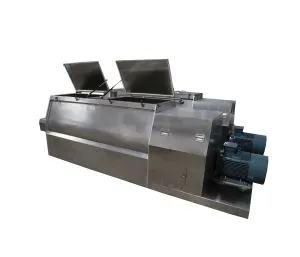
The requirements of dough mixing operation are "four fixed", that is, flour, salt, flour head and other auxiliary materials should be added in proportion and quantity; The water content should be determined according to the wet gluten content of the flour, generally 25% ~ 32%, the water content of the dough should not be less than 31%; The temperature of adding water should be controlled at about 30℃. With 15 minutes of time, winter should be long, short summer. At the end of the dough, the dough is loose and small particles, can be held into a group, gently knead to loosen the recovery, and a sense of layers in the section. The effect of horizontal linear agitator and horizontal curve agitator is better.
Dough agingThe dough shall be cooked, stored and divided by a disc ripening machine or dough aging conveyor, generally 10 ~ 15 minutes, as required The temperature and moisture of the dough should not be too different from that of the dough. The production practice has proved that the second ripening of dough after compounding is more effective and has been adopted by domestic and foreign manufacturers.
Dough rolling
Generally, the method of compound rolling and reducing roll rolling is adopted. The technical parameters are as follows:
Multiple rolling: the thickness of the first rolling sheet is usually no less than 4 ~ 5 mm, the thickness of the composite sheet is 8 ~ 10 mm, and the thickness of the final sheet is less than 1 mm, so as to ensure the rolling times are 8 ~ 10 times, making the sheet compact and smooth.
Rolling speed: in order to ensure the quality and output of the noodles, the line speed of the final roller should be 30 ~ 35 m/min.
Rolling number and ratio: 6 ~ 7 rolling number is better, the ideal calendering ratio of each roll is 50%, 40%, 30%, 25%, 15% and 10%.
Roller diameter: a reasonable method is to reduce the diameter of the roll rolling, the roller diameter is arranged for the complex phase, is less than 240 mm, less than 240 mm, less than 300 mm; In the rolling stage, the speed is less than 240 mm, less than 180 mm, less than 150 mm, less than 120 mm, or less than 90 mm.
Cutting
The strip forming is completed by the noodles cutter, the processing accuracy and installation of the cutter is often associated with the defects of the noodles such as burr, pimple, distortion, strip and width, thickness and so on. Noodles knife has integral type and combined-type, shape is square more, basic specification is divided into 1.0, 1.5, 2.0, 3.0, 6.0 millimeter 5 kinds. At present, the circular or oval blade has been developed to solve the problem of single strip. A cutting knife is arranged under the noodles knife to cut the wet noodle laterally. The rotation speed can be adjusted according to the length of each wet noodle.
The Main Technical Parameters of the Production Line
1) Cutter speed: 60 cuts/minute (square shape of noodle);
2) Shape of the noodle piece: square;
3) Width of the sliced noodle piece: 1000 mm;
4) Number of pairs of the roller: 9 pairs;
5) Index of oil of the noodle bread <= 19-21%;
6) Steam consumption: 3000kg/h; steam pressure>= 0.8 Mpa ;
7) Dough mixing time: about 17 minutes;
8) steaming time: 130 s;
9) frying time: 90s;
10) Air cooling time: 95 s;
11) Installed capacity:140 kw (packing machine not contained), 380 V, 50 Hz;
Material of Stick Noodle Production Line
Stainless steel
Stainless steel is a widely preferred material for many parts of noodle production lines due to its corrosion resistance, durability, and ease of cleaning. Components such as mixing tanks, extruders, cutting devices, and drying equipment often incorporate stainless steel.
Aluminum
Aluminum is used in some components of the production line, particularly where weight is a critical factor. While it may not be as corrosion-resistant as stainless steel, aluminum is still suitable for certain applications in noodle production equipment.
Food-grade plastics
Certain parts that come into direct contact with food, such as conveyor belts or packaging components, may be made from food-grade plastics. These materials are chosen for their non-toxic properties, ease of cleaning, and compliance with food safety standards.
Carbon steel
Carbon steel, often coated or treated for corrosion resistance, may be used in structural components of the production line. However, it is not as common in areas that directly contact food due to its potential reactivity.
Ceramics and non-stick coatings
Some cutting and shaping components may have ceramic or non-stick coatings. These materials help prevent sticking and facilitate smooth processing of the noodle dough. Non-stick coatings also make it easier to clean these components.
Rubber and silicone
Seals, gaskets, and certain parts that require flexibility and resistance to high temperatures may be made from rubber or silicone. These materials are chosen for their food-safe properties and ability to withstand the conditions of noodle production.
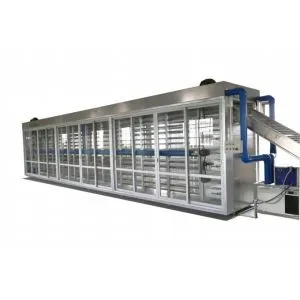
The Extrusion Process of Stick Noodle Production Line


Preparation of noodle dough
The process begins with the preparation of the noodle dough. This involves mixing flour, water, and other ingredients to create a homogeneous dough. The proportions and mixing process are carefully controlled to achieve the desired texture and taste of the final product.
Kneading and resting
The dough undergoes kneading to develop gluten, providing elasticity and structure to the noodles. After kneading, the dough is allowed to rest, allowing it to relax and the gluten to further develop. This resting period contributes to the overall quality of the noodles.
Extrusion equipment
In the extrusion process, the prepared dough is fed into an extruder. An extruder is a machine that uses mechanical force to push the dough through a shaped opening or die, resulting in the formation of noodles with a specific cross-sectional profile.
Die design
The die is a crucial component in determining the shape of the extruded noodles. It can be designed to produce various noodle shapes, such as round, flat, square, or cylindrical. The choice of die shape depends on the desired end product.
Extrusion and cutting
As the dough passes through the die, it takes on the shape of the die opening. Simultaneously, the noodles are cut to the desired length. The cutting mechanism may be integrated into the extruder or positioned downstream in the production line.
Steaming
Depending on the type of noodles being produced, there may be an optional steaming step after extrusion. Steaming can help set the shape and texture of the noodles before they undergo the drying process.
Drying
After extrusion and, if applicable, steaming, the noodles proceed to the drying stage. This step involves removing moisture from the noodles to achieve the desired texture and enhance shelf life. Drying can be done through various methods, including hot air drying or infrared drying.
Packaging
Once the noodles are fully dried, they are ready for packaging. Packaging is typically the final step in the Stick Noodle Production Line, ensuring that the noodles are protected and preserved until they reach the consumer.
The Maintenance of the Noodle Production Line Requires Skills
1.The operator should carefully study the instructions before use, and operate in strict accordance with the instructions.
2. Reversal is strictly prohibited. Replace the bearing grease every six months.
3. Before starting the machine, check whether there is any abnormal phenomenon in each part. If any problem is found, it should be dealt with in time to avoid accidents.
4. Strictly prevent iron or other hard substances from being mixed into the flour, so as not to cause damage to the machine parts.
5. It is strictly forbidden to adjust the gap between the dough rollers to more than 5 mm, and the back surface cannot be directly poured into the dough bucket.
6. When the machine is running, it is strictly forbidden to put your hands into the dangerous parts such as rollers, gears, chains, cutters, etc.
7. The clutch of single-group head (type 60, 100) rolling mill and noodle mixing machine must be clutched in the shutdown state.
8. The vermicelli production line should be idling for 10-15 minutes before pressing, and the indoor temperature should be kept above 10-15 degrees during winter production.
How The Stick Noodle Production Line Works
The working principle of the stick noodle production line is to extrude the flour through the relative rotation of the dough roller to form the dough sheet, and then cut the dough sheet by the front cutting knife to form the noodles. The shape of the noodles depends on the specifications of the noodle production line. All models can be installed with different specifications of noodle cutters, so one machine can make noodles of various specifications by replacing the noodle knives of different specifications.
Stick noodle production line is a new type of noodle assembly line equipment. The machine operates continuously from feeding to noodles. It has the advantages of high output, high efficiency, time-saving and labor-saving, and easy operation. The noodles produced have good toughness and good taste. The characteristics of the stick noodle production line are: the surface of the roll is finely ground by a grinding machine, which is smooth and beautiful, and the rolled noodles are uniform and smooth, which ensures a good quality of noodles ,Compact structure, humanized design, labor-saving work.

How the Stick Noodle Line Elevates Noodle Quality
Precision and Consistency
One of the standout features of the Stick Noodle Line is its precision in production. Noodle quality is greatly affected by factors such as dough consistency, thickness, and uniformity. The Stick Noodle Line's advanced technology ensures that these factors are meticulously controlled at every stage of the production process. This results in noodles that are consistent in texture, size, and taste, providing consumers with a reliable and enjoyable eating experience every time.
Optimal Mixing and Kneading
The foundation of excellent noodles lies in the dough itself. The Stick Noodle Line employs state-of-the-art mixing and kneading mechanisms that allow for thorough and even distribution of ingredients. This ensures that the dough is properly hydrated and developed, leading to noodles that are not only soft and chewy but also have the right elasticity. The precision in mixing and kneading ultimately translates to noodles that maintain their shape and texture during cooking.
Versatility in Noodle Types
The Stick Noodle Line's versatility is another factor contributing to the elevation of noodle quality. It has the capability to produce a wide range of noodle types, from traditional favorites to innovative creations. Whether it's ramen, udon, soba, or specialized ethnic noodles, the Stick Noodle Line can be adapted to produce noodles of varying thicknesses, lengths, and shapes. This adaptability ensures that the unique characteristics of each noodle variety are preserved, leading to an authentic and flavorful dining experience.
Advanced Cooking and Drying Techniques
Noodles go through several crucial steps after being formed, including cooking and drying. The Stick Noodle Line incorporates advanced cooking and drying techniques that optimize the quality of the final product. Noodles are cooked evenly, preventing overcooking or undercooking, and maintaining their integrity.
Certifications

Our Factory
Broadyea Machinery is a company specializing in the noodle production line. It has become an important supplier of instant noodles machine industry at home and abroad, and has a wide sales network in domestic and foreign markets. Our company's instant noodle production equipment is not only excellent in quality, leading technology, but also provide turnkey solution for the whole project, so it is welcomed by various manufacturers.Our company's sales network is very extensive, and our products are sold all over the world.

FAQ
Q: What is a stick noodle production line?
Q: What are the main components of a stick noodle production line?
Q: How is noodle dough prepared in the production line?
Q: What role do sheeting machines play in noodle production?
Q: Are there variations in the cutting process for stick noodles?
Q: How does the drying process work in noodle production?
Q: Are there different methods of drying noodles in production lines?
Q: Can stick noodle production lines be customized for different noodle varieties?
Q: What is the production capacity of a typical stick noodle production line?
Q: How is quality control maintained in noodle production?
Q: Are there considerations for raw material selection in noodle production?
Q: Can automation be incorporated into stick noodle production lines?
Q: How are hygiene and sanitation maintained in noodle production lines?
Q: What is the role of drying temperature in noodle production?
Q: Can stick noodle production lines accommodate gluten-free or specialty flours?
Q: What are common challenges in stick noodle production?
Q: How long does it take to produce stick noodles in a typical production line?
Q: Are there sustainable practices in stick noodle production?
Guangzhou Broadyea Machinery Co., Ltd. is one of the most reliable manufacturers and suppliers of stick noodle production line in China. Our factory also supports customized service. Be free to get stick noodle production line made in China from us.
Noodle Production Line Alkali Liquid, Frying Noodle Equipment Compound Rolling Machine, Hanging Noodle Machine Flour Conveying Equipment